Insights

PART II: Advance Medical Directives as an Instrument of Advance Planning in Hong Kong

Advance Medical Directives as an Instrument of Advance Planning in Hong Kong: Implementation and Best Practices for Solicitors  

1. implementation Challenges: Common Questions  

The existence of a valid AMD does not by itself guarantee that the maker’s instructions will be implemented without difficulty. One might ask: what will happen when the document is eventually needed? The principal challenges concern whether healthcare professionals know that the AMD exists, whether it applies to an unforeseen clinical situation, and how disagreements over its validity or applicability should be resolved. 

How will healthcare professionals know that an AMD exists? 

An AMD can only guide treatment if the relevant healthcare professionals have notice of it. This raises practical questions about who should retain the document, which family members or trusted persons should receive copies, and how it can be accessed during an emergency. 

Under the new framework, proof of an AMD may take the form of the original, a copy certified by a solicitor or a doctor, a paper AMD stored electronically in eHealth, or an AMD made and stored electronically through eHealth. The phased introduction of electronic storage should significantly improve accessibility, particularly where an unconscious patient is admitted without relatives or without a paper copy. 

Electronic storage does not, however, remove the need for communication. Healthcare professionals and rescuers are not required to search a patient or the patient’s belongings for an AMD or DNACPR order. Where they have no notice of a valid and applicable instrument, the governing principle is “if in doubt, save lives first”. Solicitors should advise AMD makers to tell family members, partners, carers and family physicians that an AMD exists and where it is kept. Where refusal of cardiopulmonary resuscitation is intended to operate outside a hospital setting, the distinction between an AMD and an AMD-based DNACPR order must also be understood. Execution is only the first step; communication and accessibility are integral to implementation. 

Unexpected circumstances not anticipated by the maker 

No AMD can anticipate every future illness, accident or treatment decision. This is particularly relevant where a person makes an AMD after being diagnosed with a terminal illness, but subsequently loses capacity because of an unrelated and potentially reversible event. 

The HKAM Best Practice Guidelines state that an AMD is not applicable where the attending registered medical practitioner reasonably believes that the current circumstances are “outside the reasonable expectations or could not have been reasonably anticipated” by the maker and that those circumstances would have affected the maker’s decision had they been anticipated.3 The assessment therefore concerns not only whether the maker now lacks capacity, but also whether the present clinical situation falls within the circumstances and treatment refusal that the maker intended the AMD to govern. 

Consider a patient who made an AMD refusing CPR after being diagnosed with terminal lung cancer and who subsequently suffers major trauma in a traffic accident, loses consciousness and requires immediate cardiopulmonary resuscitation. Despite the fact that the patient is terminally ill and has lost mental capacity to make medical decisions, if the treatment providers reasonably judged that the patient’s critical condition arose from the trauma rather than the underlying lung cancer, they would not incur liability for administering LST because the mere existence of a terminal illness and an AMD therefore does not mean that all future LST must be withheld.  

Applicability remains dependent on the selected precondition, the treatment refused, and whether the circumstances confronting the treatment team were reasonably within the maker’s contemplation. Where an acute event is potentially reversible and falls outside the anticipated disease trajectory, emergency treatment may properly be commenced while the patient’s condition and the applicability of the AMD are assessed. 

Disputes concerning applicability and resolution  

The distinction between validity and applicability is critical. Applicability concerns whether a valid AMD governs the clinical circumstances now confronting the treatment team. 

Applicability may be disputed where clinicians disagree about prognosis or reversibility; where the patient has both an underlying terminal illness and a treatable acute condition; or where the wording does not clearly address the treatment under consideration. Different teams may also approach the same condition from different perspectives. An oncologist may focus on the limited prognosis from the underlying disease, while an intensive-care team may regard the immediate complication as reversible.  

Although no person may override a valid and applicable AMD, such concerns may still require careful investigation before clinicians can be satisfied that it should govern the subsequent management.  

Many disagreements may be addressed through review of the AMD, contemporaneous medical records and documented discussions about the maker’s values and intentions. A multidisciplinary discussion may assist where prognosis, reversibility or the satisfaction of a clinical precondition is uncertain.  

Where uncertainty remains unresolved, the Ordinance permits an application to the Court of First Instance for a declaration as to whether an AMD is valid, applicable, or both. Treatment providers and specified persons with a sufficiently close relationship to the patient may apply without first obtaining leave of the Court. Pending determination, where the patient is in an urgent and critical condition, LST may need to continue in accordance with the patient’s best interests. 

Court proceedings should nevertheless remain a last resort. The more effective safeguards are earlier ones: clear instructions, adequate medical explanation, contemporaneous documentation, communication with trusted persons, accessible storage, and regular review as the maker’s health and circumstances change. 

2. Best Practices for Solicitors 

Solicitors are increasingly advising clients on a concurrent tripartite estate planning framework: a Will, an Enduring Power of Attorney, and an AMD, which all pivot fundamentally on the issue of mental capacity. Addressing clients’ concern over future disputes on this issue, an inter-professional approach by the medical and the legal profession will be more important than ever.  

First, the importance of good documentation of the client’s instructions and capacity assessment cannot be overstated in light of section 21 of the Ordinance. As mentioned above, it governs applications to the Court of First Instance (CFI) for a declaration. 

Under section 21(1) the CFI may determine: 

(a) whether an instrument that purports to be an AMD made by a person is an 

AMD made by the person; or 

(b) whether an instruction in an AMD is (i) valid; (ii) applicable; or (iii) valid and applicable. 

Under section 21(3), no leave is required for an application under section 21(1) if the application is made by— 

(a) a treatment provider of the affected person of the application; 

(b) a person who has a contractual arrangement with a treatment provider of the affected person under which the treatment provider is obliged to provide medical care to the affected person; 

(c) an immediate family member of the affected person; 

(d) a cohabitee of the affected person; or 

(e) a person who is not an immediate family member, or a cohabitee, of the affected person but is, under subsection (4), eligible to act. 

If an application under section 21 is being anticipated (e.g. on the ground that the AMD is invalid due to a lack of capacity or undue influence), the detailed attendance notes by the doctor and, if appropriate, the solicitor, will be critical to safeguarding the wishes of the maker of the AMD. For this reason, clients should be advised on engaging the solicitor who has drafted his/her will to act as a witness for the AMD. 

Meanwhile, solicitors should familiarize themselves with Practice Direction 40, which shall come into effect together with the Ordinance on 31 July 2026. In addition to highlighting the key information to be included in the evidence, PD40 addresses essential procedural mechanics: who must be joined as a party (such as the AMD maker and persons with a sufficient interest), service, and notice requirements for ex parte applications. Importantly, it also highlights key considerations for the first directions hearing and provides practical guidance for urgent applications. 

Secondly, given the central role of a medical doctor in the making of an AMD, solicitors should not limit themselves to enquiring into clients’ rationale for their proposal of estate planning, but also their health conditions. This will allow the solicitor to advise or recommend a doctor of suitable specialty for assessing mental capacity of each instrument, based on the client’s medical history.  

This is especially important where the client is of advanced age, or he/she has already been diagnosed with neurodegenerative illness. If a client already suffers from a condition with fluctuating capacity, the medical consultation must take place within a documented period of lucidity.  

Thirdly, drawing on case law from probate litigation, in which significant weight is placed on a drafting solicitor’s contemporaneous notes for proving testamentary capacity, a solicitor who has worked with the client over time should advise on the pros and cons of sharing his notes with the assessing doctor, subject to the client’s express waiver of legal professional privilege for this limited purpose. 

Provided with such materials, the medical doctor gains critical contextual insight. They are no longer performing a “cold” clinical assessment on an unfamiliar patient; instead, they can evaluate the client’s current cognitive state against their documented instructions on their estate planning instruments. This will enable the medical doctor to conduct a more informed and legally defensible evaluation on mental capacity especially in cases where the will has been executed contemporaneously with the AMD. 

Regular Review, Updating and Communication 

An AMD should be reviewed as its continuing value depends on whether it accurately reflects the maker’s current medical circumstances, values and treatment preferences at the time it is eventually relied upon. 

Review should be considered following a new diagnosis, progression of an existing condition, a material change in prognosis, or the availability of new treatment options. Other appropriate review points may include major surgery, admission to residential care, changes in family or relationship circumstances, the unavailability of a trusted contact, or a change in the maker’s personal values or views about LST. A change in medical condition may alter the relevance of the original preconditions, the likely benefits and burdens of treatment, or the maker’s understanding of the outcomes that the AMD was intended to address. 

Regular review is particularly important for healthy individuals who may make an AMD many years before it becomes applicable. The HKAM Best Practice Guidelines recognise that some healthy adults, including those engaging in higher-risk activities may wish to plan for the possibility of a sudden catastrophic injury. However, the longer the interval between making and implementing an AMD, the greater the possibility that the maker’s health, treatment options or preferences may change. Periodic review helps demonstrate the continuing stability and relevance of the AMD. 

Communication is equally important. Where appropriate, makers should inform close family members, partners, next of kin, trusted persons and their family doctor of the existence and location of the AMD, as well as any subsequent amendment or revocation. Family involvement is not required to validate the maker’s decision and does not give relatives a right to override it. Nevertheless, timely communication can reduce uncertainty, and minimise disputes when the maker can no longer explain their wishes. 

Regular review and open communication therefore provide practical safeguards that help ensure the AMD continues to represent the maker’s current intentions rather than merely recording a decision made many years earlier. 


3. Conclusion 

The Ordinance gives AMDs greater legal certainty and a clearer statutory framework. Its significance, however, extends beyond terminal illness, palliative care and the final stages of life. 

AMDs should increasingly be understood as instruments of medical autonomy for healthy and ill individuals alike. For solicitors practising in probate, family, private-client and incapacity planning, they form part of a broader advance-planning conversation alongside wills and Enduring Powers of Attorney. Each instrument addresses a different aspect of autonomy, but all respond to the same fundamental concern: what should happen when a person can no longer speak or act for themselves? 

The Ordinance provides the legal infrastructure for advance decision-making. Its wider success will depend on whether AMDs become part and parcel of advance planning in Hong Kong. 

Legal recognition alone will not ensure effective implementation. The practical value of an AMD depends on informed decision-making, careful assessment of mental capacity, clear instructions supported by adequate medical explanation, communication with family members and trusted persons, accessibility at the point of care, and regular review as health and personal circumstances change.  


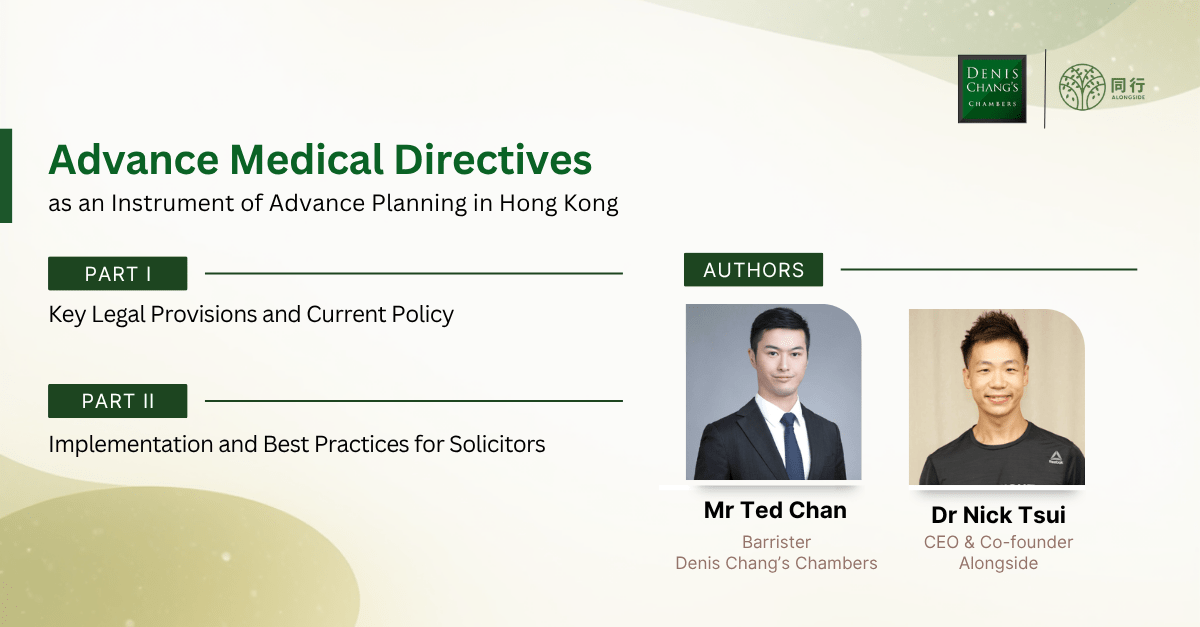
Authored by Ted Chan and Dr. Nick Tsui.


Ted Chan

Ted has a broad civil and criminal practice. He has been regularly instructed to advise and/or handle probate, family and mental health cases. His experiences in handling cases with children and mental health dimensions also extend across different areas of law. Meanwhile, Ted continues to develop a wide range of practice areas including civil and commercial disputes. 

Ted is also a CEDR accredited mediator and has regularly been engaged in mediations of a wide variety of disputes, such as contract, restitution, matrimonial, nuisance, defamation, building management, etc. 

From 2017 to 2018, Ted was appointed as a Judicial Assistant in the Court of Final Appeal. He was responsible for conducting legal research for the judges, and preparing judicial bulletins and press summaries. 

More details can be found in Ted’s profile.


Dr. Nick Tsui

Dr. Nick Tsui is the CEO and Co-founder of Alongside. He graduated from the Medical School of The Chinese University of Hong Kong (CUHK) and is professionally trained as a specialist anaesthesiologist. With over a decade of experience in public hospitals, he is now in private practice and is currently serving as an anaesthesiology fellowship examiner. He is also qualified in simulation-based education, reflecting his passion for training and medical simulation education.

Nick further extended his professional interests into the medicolegal field, earning an LLM in Medical Laws and Ethics from the University of Edinburgh with a focus on medical negligence and end-of-life ethics. This additional expertise enhances his understanding of the legal and ethical dimensions of patient care.


This article was first published on 14 July 2026.

Disclaimer: This article does not constitute legal advice and seeks to set out the general principles of the law. Detailed advice should therefore be sought from a legal professional relating to the individual merits and facts of a particular case. The photographs which appear in this article are included for decorative purposes only and should not be taken as a depiction of any matter to which the case is related. The views and opinions expressed in this article/material are solely those of the members authoring it and do not necessarily reflect the official policy or position of Denis Chang’s Chambers, or of any other member or members of Denis Chang’s Chambers.