The enactment of the Ordinance marks an important development in the legal recognition of Advance Medical Directives (“AMDs”) in Hong Kong. Passed in November 2024, the Ordinance will commence on 31 July 2026. The Ordinance places the making, recognition and implementation of AMDs on a statutory footing, while providing greater certainty for members of the public, healthcare professionals and rescuers.
Historically, AMDs in Hong Kong have been primarily associated with end-of-life and palliative care, particularly for patients with advanced or terminal illness under the care of oncology or palliative-care teams. In that setting, an AMD is often discussed only when deterioration is foreseeable and decisions concerning life-sustaining treatment (“LST”) are becoming imminent, with a view to avoiding non-beneficial treatment and unnecessary suffering.
The new statutory framework creates an opportunity to broaden that understanding. AMDs should increasingly be viewed as instruments through which both healthy and terminally-ill individuals alike may preserve their medical autonomy before incapacity or crisis occurs. Individuals may be motivated by a desire to avoid unwanted intervention, reduce the decision-making burden on loved ones, address complex family arrangements, or ensure that their values remain effective when they can no longer communicate.
For solicitors, this development is particularly significant. Just as wills preserve testamentary autonomy and Enduring Powers of Attorney support financial decision-making during incapacity, AMDs protect medical autonomy while the maker remains alive but is no longer capable of deciding on LST. They should therefore be considered as part and parcel of mainstream advance planning.
2. Provisions of the Ordinance
Although AMDs operated at common law even before the enactment of the Ordinance, there were considerable legal ambiguities for the general public, doctors and rescuers. The Ordinance now provides a codified legal framework to give statutory backing to AMDs.
What is an AMD?
An AMD is defined under section 2(1) of the Ordinance as “an instrument made by a person that contains one or more instructions that if the person is mentally incapable of deciding on a life-sustaining treatment and the specified precondition of the instruction is met, the person is not to be subjected to any life-sustaining treatment specified in the instruction”.
Where a patient has expressed by way of an AMD his/her wish to refuse the LST, it will be lawful for the doctor to withhold or withdraw the LST. Note, however, an AMD is only concerned with LSTs and therefore basic care (such as the provision of food and drink by mouth) or palliative care will be beyond the scope of AMDs.
Conditions to be Met
To be legally valid and enforceable, certain conditions must be met at the time of execution:
1. At the time of making the advance medical directive, the maker of the AMD must be an adult; and mentally capable of deciding on a LST;
2. The AMD must be made, in writing, in paper form and all instructions in the AMD must be presented in a clear way. Subject to contrary evidence, this condition is presumed to have been met if Form 1 or 2 (as appropriate) prescribed in Schedule 2 of the Ordinance is adopted;
3. The maker must sign the AMD, and the date of signing must be shown in the AMD; and
4. The AMD is signed in the presence of no less than 2 witnesses, who are adults and are, to the best of his/her knowledge, not an interested person of the maker.
Importantly, in order to satisfy the condition regarding witnesses, one of them must be a medical doctor, who is charged with the following responsibilities:
1. Prior to the maker signing the AMD, the doctor must have explained the nature of the AMD; and, in relation to each of the instructions in AMD, the effect of following it on the maker.
2. The doctor is satisfied that the maker is mentally capable of deciding on LST at the time when the maker signs the AMD.
3. The doctor declares in the AMD that he/she meets the above two requirements.
Any AMD executed prior to the commencement date (e.g. those using Hospital Authority templates) will remain legally valid and enforceable, provided they satisfy the above statutory requirements as set out in the Ordinance.
When is the AMD Triggered?
As can be seen from the statutory definition of an AMD, the first requirement triggering an AMD will be that the maker becomes mentally incapable of deciding on a LST.
The incapacity to do so means, under section 3(2), that “if the person is suffering from an impairment of, or a disturbance in the functioning of, the mind or brain and as a result, the person is unable to:
(a) understand any information relevant to deciding whether to be subjected to a life-sustaining treatment;
(b) retain that information;
(c) use or weigh that information in making the decision; or
(d) communicate the decision.”
Sub-section 3(3)-(8) provides further boundaries on how mental incapacity is evaluated when these criteria are being considered, preventing arbitrary or overly broad assumptions.
Secondly, the AMD will be triggered when any of the specified preconditions (namely, the condition(s) precedent that is specified in the AMD for following the instruction) has arisen.
1. The maker is terminally ill (within the meaning of section 4).
2. The maker is in a persistent vegetative state or irreversible coma (within the meaning of section 5).
3. The maker is in other end-stage, irreversible, life-limiting condition (within the meaning of section 6).
Importantly, the maker possesses full autonomy to condition their directive upon one or more of the above specified preconditions. For each selected precondition, the maker may precisely customize the scope of their refusal by either specifying the exact types and parameters of LST to be withheld or withdrawn (e.g., refusing all LSTs except artificial nutrition and hydration), or issuing a blanket refusal against the administration of any and all forms of LST.
Reference can be made to Part 3 of Form 1 or Form 3 of Schedule 2, for an understanding of how these options may be structured.
What is a Validating Copy?
Under section 2, a validating copy of an AMD can be any of the following:
1. The original copy of the AMD.
2. A copy of the AMD that is certified as a true copy of the AMD by a registered medical practitioner or a solicitor practising in Hong Kong.
3. A clearly legible copy of the AMD that is in the form of an electronic image; and is stored in a designated electronic system in compliance with the requirements of the system.
Can the AMD be revoked?
Under section 13, the AMD can be revoked at any time when the maker has the mental capacity to do so. The AMD will be revoked if any of the following takes place:
1. The maker revokes the AMD in writing, whether in paper form or in electronic form;
2. If the AMD was made in the form of Form 1 or 2 prescribed in Schedule 2, the maker signs Part 5 of the AMD, and the date of signing is shown in that Part;
3. The maker, or an adult in the maker’s presence and by the maker’s direction (i) burns, tears or otherwise destroys the AMD; or (ii) crosses out the content of, and signs, each page of the AMD.
4. In the presence of one or more witnesses who are adults, the maker (i) revokes the AMD verbally; or (ii) by any means other than written or verbal communication, expresses his or her intention to revoke the AMD.
5. The maker makes another AMD.
6. The maker, or an adult in the maker’s presence and by the maker’s direction, takes the steps required by a designated electronic system for revoking the AMD (whether or not a validating copy of the AMD is stored in the system).
Protection of Treatment Providers
On the one hand, the treatment provider incurs no criminal, civil, or professional disciplinary liability for withholding or withdrawing LST if he/she honestly and reasonably believes that the treatment is specified in an instruction of an AMD made by the person; and the instruction is valid and applicable.
On the other hand, the framework equally insulates the treatment provider who administers or continues LST, provided they were genuinely unaware of the AMD at the material time, or is not satisfied that (i) the treatment is specified in an instruction of an AMD made by the person; or (ii) the instruction is valid and applicable.
3. From Terminal Illness to Advance Planning: Experience from Community Practice
AMDs have traditionally developed in Hong Kong within an illness-led and institution-based pathway. Since 2010, the Hospital Authority (“HA”) has facilitated the making of Advance Directives for terminally ill patients who satisfy the relevant clinical conditions. The number made within HA rose from 325 in 2013 to 2,070 in 20251, reflecting a substantial increase in awareness and acceptance over the past decade. Nevertheless, the Government’s latest implementation paper2 continues to situate AMDs within advance care planning for patients with advanced or irreversible illness. At present, advance care planning is primarily implemented within HA’s palliative care, oncology and geriatric services, with discussions generally initiated at clinical trigger points such as marked functional decline, entry into the late stage of disease, or a transition from curative to palliative treatment.
This pathway remains essential for patients approaching the later stages of illness. It does not, however, fully reflect the broader population that may wish to make an AMD before any such clinical trigger arises.
Alongside, as a social enterprise supported by the HKEX Foundation and the Social Innovation and Entrepreneurship Development Fund, has in the past two years provided AMD education and support and has facilitated more than 200 AMDs for members of the public. Its experience offers an emerging picture of AMD-making outside the conventional hospital and palliative-care setting.
As of 31 May 2026, the AMD makers assisted by Alongside ranged from 21 to 94 years of age, with a mean age of 61.7. Nearly half of them were below the retirement age of 65, presenting a clear contrast to the traditional assumption that AMDs are primarily relevant to elderly or terminally ill patients. In terms of health status, approximately 73.6% were either healthy or living only with mild systemic conditions, such as controlled hypertension or hypercholesterolaemia. Only around 8% were terminally ill at the time of making their AMD.
These observations suggest that community demand is not driven solely by imminent death or advanced disease. Many makers approached AMD-making as a form of prospective planning: they wished to consider difficult medical choices while they remained well, mentally capable and able to communicate their values clearly. Their motivations included preserving control over future treatment, avoiding unwanted invasive intervention, relieving loved ones from having to make decisions in a crisis, reducing the risk of family disagreement, and ensuring that a partner or trusted person understood their wishes. Others had witnessed distressing experiences involving prolonged treatment or difficult end-of-life decisions within their own families and wished to avoid leaving similar uncertainty for those close to them.
More than 95% of Alongside’s clients elected, upon fulfilment of their chosen preconditions, to refuse all forms of LST covered by their AMDs, including artificial nutrition and hydration. This should not be understood as an unwillingness to live or a rejection of appropriate medical care. Rather, many makers expressed a wish not to have biological life prolonged where meaningful recovery, interaction or an acceptable quality of life was no longer possible. Their decisions were therefore grounded in a positive conception of autonomy: they wished to determine in advance what outcomes would remain consistent with their own values, dignity and understanding of a meaningful life.
The principal barrier emerging from community practice is therefore not necessarily a lack of motivation, but accessibility. HA’s AMD pathway prioritises patients with advanced illness and those already receiving oncology, geriatric or palliative care. Comparatively healthy individuals who wish to plan earlier may not yet fall naturally within that pathway. Legal practitioners who understand the statutory requirements and their clients’ health issues will be better placed to discuss the making of AMDs privately.
The potential demand is likely to be substantial. Whilst medical doctors are required by law to explain the clinical consequences of treatment refusal and assess capacity, solicitors should recognise AMDs as part of broader advance planning and can act as a witness provided that they are free of conflict.
Continue reading Part II: Implementation and Best Practices for Solicitors.
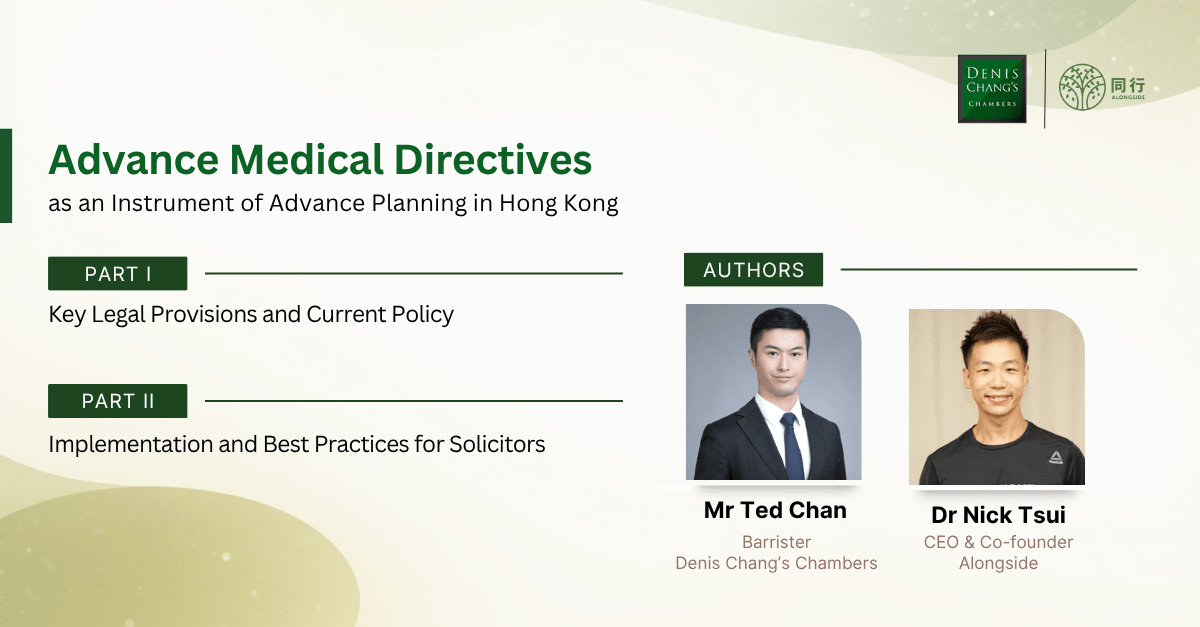
Authored by Ted Chan and Dr. Nick Tsui.
Ted Chan

Ted has a broad civil and criminal practice. He has been regularly instructed to advise and/or handle probate, family and mental health cases. His experiences in handling cases with children and mental health dimensions also extend across different areas of law. Meanwhile, Ted continues to develop a wide range of practice areas including civil and commercial disputes.
Ted is also a CEDR accredited mediator and has regularly been engaged in mediations of a wide variety of disputes, such as contract, restitution, matrimonial, nuisance, defamation, building management, etc.
From 2017 to 2018, Ted was appointed as a Judicial Assistant in the Court of Final Appeal. He was responsible for conducting legal research for the judges, and preparing judicial bulletins and press summaries.
More details can be found in Ted’s profile.
Dr. Nick Tsui

Dr. Nick Tsui is the CEO and Co-founder of Alongside. He graduated from the Medical School of The Chinese University of Hong Kong (CUHK) and is professionally trained as a specialist anaesthesiologist. With over a decade of experience in public hospitals, he is now in private practice and is currently serving as an anaesthesiology fellowship examiner. He is also qualified in simulation-based education, reflecting his passion for training and medical simulation education.
Nick further extended his professional interests into the medicolegal field, earning an LLM in Medical Laws and Ethics from the University of Edinburgh with a focus on medical negligence and end-of-life ethics. This additional expertise enhances his understanding of the legal and ethical dimensions of patient care.
This article was first published on 14 July 2026.
Disclaimer: This article does not constitute legal advice and seeks to set out the general principles of the law. Detailed advice should therefore be sought from a legal professional relating to the individual merits and facts of a particular case. The photographs which appear in this article are included for decorative purposes only and should not be taken as a depiction of any matter to which the case is related. The views and opinions expressed in this article/material are solely those of the members authoring it and do not necessarily reflect the official policy or position of Denis Chang’s Chambers, or of any other member or members of Denis Chang’s Chambers.