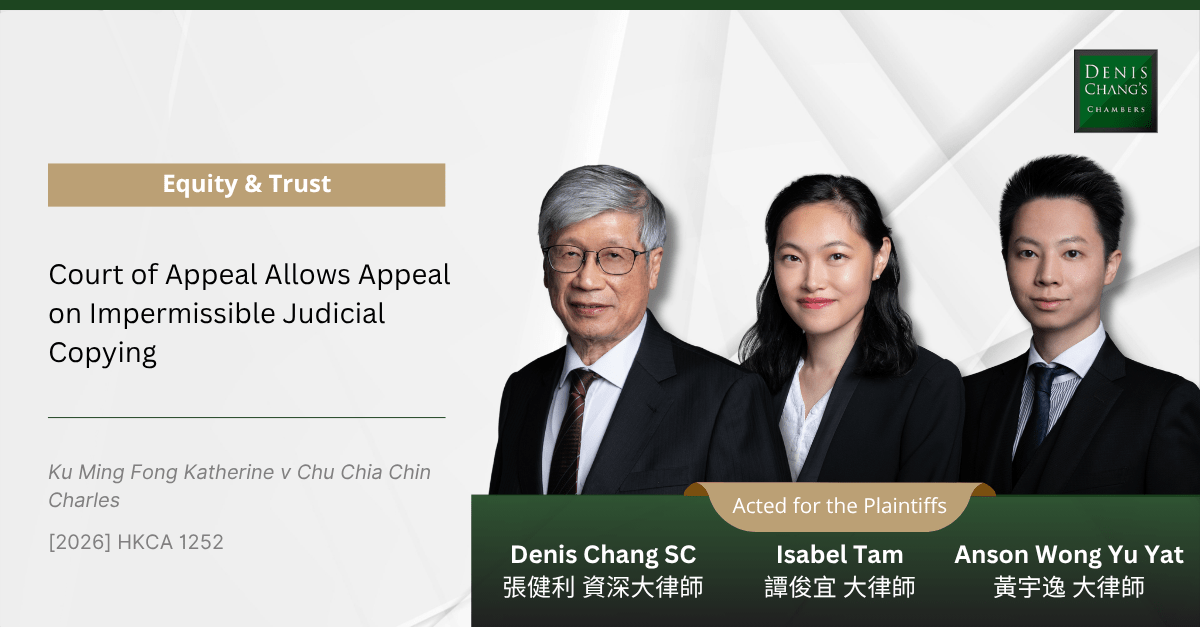
Court of Appeal Allows Appeal on Impermissible Judicial Copying
Equity & Trust
On 15 July 2026, the Court of Appeal handed down Reasons for Judgment in CACV 427/2024 ([2026] HKCA 1252) allowing the Plaintiffs’ appeal on the ground of impermissible judicial copying. Denis Chang SC, Isabel Tam and Anson Wong Yu Yat acted for the successful Plaintiffs on appeal.
The Plaintiffs claimed that a trust of some shares in Lully Corporation (“Lully” and “Lully Shares”) was declared and constituted by a conversation between Mr Koo Ming Kown (the 4th Plaintiff) and Mr Charles Chu (the Defendant) in 1995. Lully was then a majority shareholder of Nam Tai Electronics Inc (南太電子有限公司), a listed company on Nasdaq and the New York Stock Exchange. This trust was for the benefit of the 1st Plaintiff, the 2nd and 3rd Plaintiffs (being the 1st Plaintiff’s two children by her first marriage; “Leung Children”) and the 1st Plaintiff’s three children from her second marriage to the Defendant (“Chu Children”), with the Defendant as the trustee. The Plaintiffs claimed that the Defendant had breached the oral trust and his fiduciary duties towards the 1st to 3rd Plaintiffs, by converting the Lully Shares for his own use, by failing to hold the trust property for the benefit of the beneficiaries and/or for the upbringing of the Leung Children and the Chu Children.
This is an appeal by the 1st to 4th Plaintiffs against the judgment of Wilson Chan J handed down on 13 September 2024 (“CFI Judgment”) after a trial on liability which lasted for eight days in March 2024. At the forefront of this appeal is the complaint of impermissible judicial copying. Almost 95% of the CFI Judgment comprises passages copied from the opening and closing submissions of the Defendant’s counsel.
Kwan VP (giving the Reasons for Judgment of the Court of Appeal) held:
(1) Apart from the extent of the copying, the quality of the copying leaves one in little doubt it could not have been apparent that the judge had applied an independent mind to bear on the important issues he was required to decide.
(2) The good impression created by the display of judicial temperament and active engagement with counsel throughout the hearing cannot effectively displace the impression given by a judgment of extensive copying that the judge has subsequently abdicated his core judicial responsibility to think through for himself the issues he has to decide. The judge’s task in bringing his own mind to bear on the issues and demonstrating it by expressing in his own language how he reached a finding cannot be substituted by his expressions of interest in or engagement with the issues during the hearing.
Accordingly, the Court of Appeal allowed the appeal and ordered a re-trial before another judge on liability.
Subsequently, on 27 July 2026, the Chief Justice issued a statement on behalf of the Judiciary, reiterating, inter alia, that:
“The primary duty of a judge in adjudicating cases is to hear and determine them in accordance with the applicable law and the evidence presented before the court. In doing so, a judge must exercise an independent judicial mind in carefully considering and resolving the issues raised and in determining the disputes before the court. The exercise of independent judicial judgment, which lies at the heart of the adjudicative process, is principally reflected in the reasons and judgments delivered by the judge.
Judicial copying strikes at the very core of this fundamental requirement. It raises serious concerns as to whether a judge has brought an independent mind to bear on the issues and disputes requiring determination. Such conduct is wholly unacceptable.”
The Chief Justice has also taken this opportunity to remind judges and judicial officers at all levels of the court system of the importance of avoiding any form of judicial copying.
Denis Chang SC
“Supreme at strategic planning of litigation. He takes a holistic view and his rich legal knowledge and experience means he is able to anticipate parties’ reactions accurately.”
Legal 500 Asia-Pacific 2021-2026, Commercial Disputes – Tier 1 Leading Silk
Denis Chang is a Senior Counsel in private practice, Head of Denis Chang’s Chambers, Honorary Professor at HKU’s Law Faculty, and Council Chair of St Francis University. Appointed Queen’s Counsel in 1981, he has served as Chairman of the Hong Kong Bar Association, member of the Executive Council, and Executive Committee Member of the Basic Law Consultative Committee etc.
Visit Denis Chang SC’s profile for more details.
Isabel Tam

“She’s very articulate and is good at attention to detail. She gives us comprehensive advice that is very practical. I think she’s a good advocate.”
Chambers and Partners Greater China Region 2026
Administrative & Public Law: The Bar and Family/Matrimonial: The Bar
Recognised as Leading Junior in Legal 500 (2026, Administrative and Public Law & Family and private client) and ranked in Chambers and Partners Greater China Region 2026 (Administrative & Public Law: The Bar and Family/Matrimonial: The Bar), Isabel’s practice focuses on family law, public law, and regulatory matters. She has extensive experience in general matrimonial finance and preservation of assets, as well as particular expertise in complex legal issues arising out of LGBTQ/modern families and the dissolution of families with cross-border elements. She has acted as sole counsel in the Court of Appeal, Court of First Instance, District Court, Magistrates’ Courts, and the Court of Final Appeal.
Isabel has been involved in landmark family law cases concerning modern families and LGBTQ rights in Hong Kong. Notably, she represented the non-biological parent in AA v BB [2021] 2 HKLRD 1225, securing guardianship and joint custody for a same-sex couple. She was involved in NF v R [2023] 5 HKLRD 58, a case resulting in a novel type of relief, a declaration of “parentage at common law” for a same-sex parent. Her expertise in family law is augmented by her experience in other related areas including in particular tax (Koo Ming Kown & Anor v The Commissioner of Inland Revenue [2021] 3 HKLRD 642 on liability for additional tax), mental incapacitated persons, and trust claims.
She is a contributor to the current editions of Hong Kong Civil Procedure and Bullen & Leake & Jacob’s Hong Kong Precedents of Pleadings.
View Isabel’s profile for more details.
Anson Wong Yu Yat
“ Anson is a hardworking counsel whose legal knowledge is impressive. He is willing to test different arguments and go the extra mile for clients. His advocacy is excellent.”
“Anson has an exceptional ability to distill complex information into clear, high-level insights. It’s truly a pleasure to work with him.”
Legal 500 Asia-Pacific 2026
Administrative and Public Law – Tier 1 Leading Junior; Commercial Disputes – Leading Junior
Anson has appeared in more than 200 court judgments (including 20 cases in the Court of Final Appeal with 14 substantive appeals) over the mere span of 11 years’ call, reflecting the exceptional wealth of experience and exposure in civil litigation for his seniority.
Anson has developed a broad civil practice with particular interest in intellectual property and competition law matters. He is experienced in handling complex questions of law, including those of great general or public importance which reached the Court of Final Appeal. For example, he has recently appeared in (among others) three civil appeals before the Court of Final Appeal dealing with important questions concerning insolvency matters, land law and equity, service out of jurisdiction and statutory interpretation (see Re Hsin Chong Construction Co Ltd (2021) 24 HKCFAR 98, Cheung Lai Mui v Cheung Wai Shing (2021) 24 HKCFAR 116 and Fong Chak Kwan v Ascentic Ltd (2022) 25 HKCFAR 135 and Yim Tin Fook v To Sze On [2026] HKCFA 17). He also appeared in one of the first two enforcement actions before the Competition Tribunal, arguing issues relating to the burden and standard of proof as well as the proper approach for the determination of pecuniary penalties (see Competition Commission v W Hing Construction Co Ltd [2019] 3 HKLRD 46; [2020] 2 HKLRD 1229).
Please visit Anson’s profile for more details.
This article was first published on 29 July 2026.
Disclaimer: This article does not constitute legal advice and seeks to set out the general principles of the law. Detailed advice should therefore be sought from a legal professional relating to the individual merits and facts of a particular case. The photographs which appear in this article are included for decorative purposes only and should not be taken as a depiction of any matter to which the case is related. The views and opinions expressed in this article/material are solely those of the members authoring it and do not necessarily reflect the official policy or position of Denis Chang’s Chambers, or of any other member or members of Denis Chang’s Chambers.